What is the Chinese zodiac sign for 1915?
For most people born in 1915, the Chinese zodiac sign is Rabbit and the year element is Wood. The simple answer is: 1915 is the Year of the Wood Rabbit. The accuracy detail is that BaZi does not treat January 1 as the year boundary. In this archive, the 1915 BaZi year begins at Li Chun, February 4, 1915 at 9:20 PM UTC (1915-02-05 05:20 HKT). If your birthday is before that moment, your year pillar may still be Wood Tiger. This gives the direct year answer first, but the safest reading still uses the exact birth date because Chinese zodiac year boundaries do not always match January 1.
1915 Chinese zodiac element and animal at a glance
1915 belongs to the Wood Rabbit combination in the 60-year cycle. The animal gives the visible zodiac language; the element changes the tone. That is why 1915 Rabbit is not the same as every other Rabbit year. A Wood Rabbit year should be read as one complete element-animal phrase, not just as 'Rabbit'. People often search the animal alone, but the element is what separates a Wood Rabbit from other Rabbit years. This is why two Rabbit years twelve years apart can feel very different in BaZi interpretation.
1915 Rabbit personality themes
Rabbit years carry refinement and diplomatic intelligence. People born in Rabbit years often read the emotional weather first, choose words carefully and prefer progress that does not leave casualties. The traditional strength is tact; the traditional cost is swallowing discomfort until it compounds. Commonly listed themes for Rabbit years include sensitivity, diplomacy, taste and social timing — useful as entry points, never as a final verdict on a person. This is where the page moves beyond a lookup table. Rabbit themes can describe how a person is first read by others, but the free report can show whether those themes are strong, hidden or balanced by other pillars.
1915 Chinese zodiac element: Wood
Wood adds growth, planning and direction. It can make the animal more developmental, people-oriented and concerned with long-term expansion. People often search the animal alone, but the element is what separates a Wood Rabbit from other Rabbit years. This is why two Rabbit years twelve years apart can feel very different in BaZi interpretation.
Best Chinese zodiac compatibility for 1915 Rabbit
Traditional Chinese zodiac compatibility often links Rabbit with Goat, Pig, Dog. This is useful for quick searches such as 'Rabbit compatibility', but it is still only a year-sign comparison. A real love, marriage or business reading should compare both people's full Four Pillars charts. In relationships, Rabbit years give attentive, aesthetic care and need the same consideration named back explicitly. Use this as a reading note rather than a fortune label. The strongest next step is to generate a free BaZi report and compare the 1915 year pillar with the rest of the chart.
Where this year sits in the 60-year cycle
1915 sits at position 52 of the 60-year stem-branch cycle. That is why the same animal returns every 12 years, but the same element-animal combination only returns every 60 years. This is why exact-year pages matter. The 12-year animal cycle repeats quickly, but the full element-animal combination gives 1915 its own tone inside the wider 60-year rhythm.
Related Rabbit years
1903 and 1927 share the same animal but not the same full element-animal cycle. 1975 is the closest matching 60-year combination in this archive. Related-year comparison is useful because people often check parents, partners or children across different generations. Comparing 1915 with nearby Rabbit years can show what repeats every 12 years and what only repeats when the element returns.
Work and study pattern for a Rabbit year
Rabbit years bring sensitivity to people and atmosphere. Work usually improves when communication, taste and emotional safety are handled carefully. In study and work, Rabbit years shine where taste, care and client trust decide outcomes: design, teaching, mediation and service. This is not career prediction. It is a practical reading lens: if the year pillar is prominent in a chart, these patterns may appear in school habits, work rhythm, public role or how the person handles pressure from their environment.
Wood Rabbit practical takeaway
Practical takeaway: grow with a plan. Wood years are good for development, but every new branch still needs roots and maintenance. The Rabbit's trap is mistaking swallowed discomfort for harmony when it is really deferred conflict with interest. The takeaway is designed to turn Chinese zodiac information into something usable. Instead of asking whether Wood Rabbit is good or bad, ask what behaviour, pace or boundary makes this combination work better.
How your 1915 pillar meets the 2027 Fire Goat year
Your 1915 year pillar is 乙卯 (乙 stem, 卯 branch). Against the 2027 Fire Goat year, your Wood stem feeds the year's Fire — effort converts into visibility unusually easily, which rewards choosing what deserves the spotlight rather than lighting everything In practice, keep a shortlist of what deserves the extra spotlight your effort attracts.; and your Rabbit branch has no listed direct conflict with the Goat branch — cooperation flows without special friction, but also without automatic tailwind. At about 112 years old in 2027, this combination usually lands in the territory of For the oldest cohorts, the Fire Goat year usually surfaces care duties inside the family archive: who holds the documents, who visits whom, and whose version of an old story gets preserved. A practical use of 2027 for this pillar is writing down arrangements while conversations are still easy, so the next generation inherits clarity instead of guesswork. Read all of this as one interaction layer between birth pillar and current year — the full chart still decides how strongly it lands. Use this as a reading note rather than a fortune label. The strongest next step is to generate a free BaZi report and compare the 1915 year pillar with the rest of the chart.
Rabbit-year moves worth trying
Three usable moves for a Rabbit year: prepare one reusable graceful refusal; price one habitual free service; book calm hours into the calendar as immovable appointments. Use this as a reading note rather than a fortune label. The strongest next step is to generate a free BaZi report and compare the 1915 year pillar with the rest of the chart.
What to check for people born in 1915
Older records and family context may matter more for this year because calendar conversion, remembered birth time and birthplace can all affect a full chart. If the chart is built from a remembered time rather than a documented one, treat the hour pillar as tentative and re-read the balance once documents surface. For older years this may mean checking family records; for younger years it may mean avoiding fixed labels too early. Either way, a year page is the doorway, while the full report gives the personal context.
If you were born near Chinese New Year
Do not rely only on the Western calendar year. Many Chinese zodiac lists use Lunar New Year for popular zodiac lookup, while BaZi uses the solar-term boundary around Li Chun. For this 1915 page, the BaZi boundary is February 4, 1915 at 9:20 PM UTC. Someone born before that boundary may belong to Wood Tiger, even if the Western calendar year is 1915. This is one of the most important accuracy issues for Chinese zodiac calculators. A person born near the year boundary may receive the wrong animal if a tool only uses the Western calendar year and ignores solar-term timing.
Year animal versus full BaZi chart
The year pillar is the public doorway of the chart. The month pillar often speaks more about work rhythm and social environment, the day pillar is closer to self and close relationships, and the hour pillar can show later-life focus, children, ambition and private drives. This distinction is central to GlobalBazi: Chinese zodiac explains one visible layer, while BaZi reads the whole structure. The same 1915 birth-year animal can mean different things depending on Day Master, element balance and hidden stems.
How relationship readings use this year
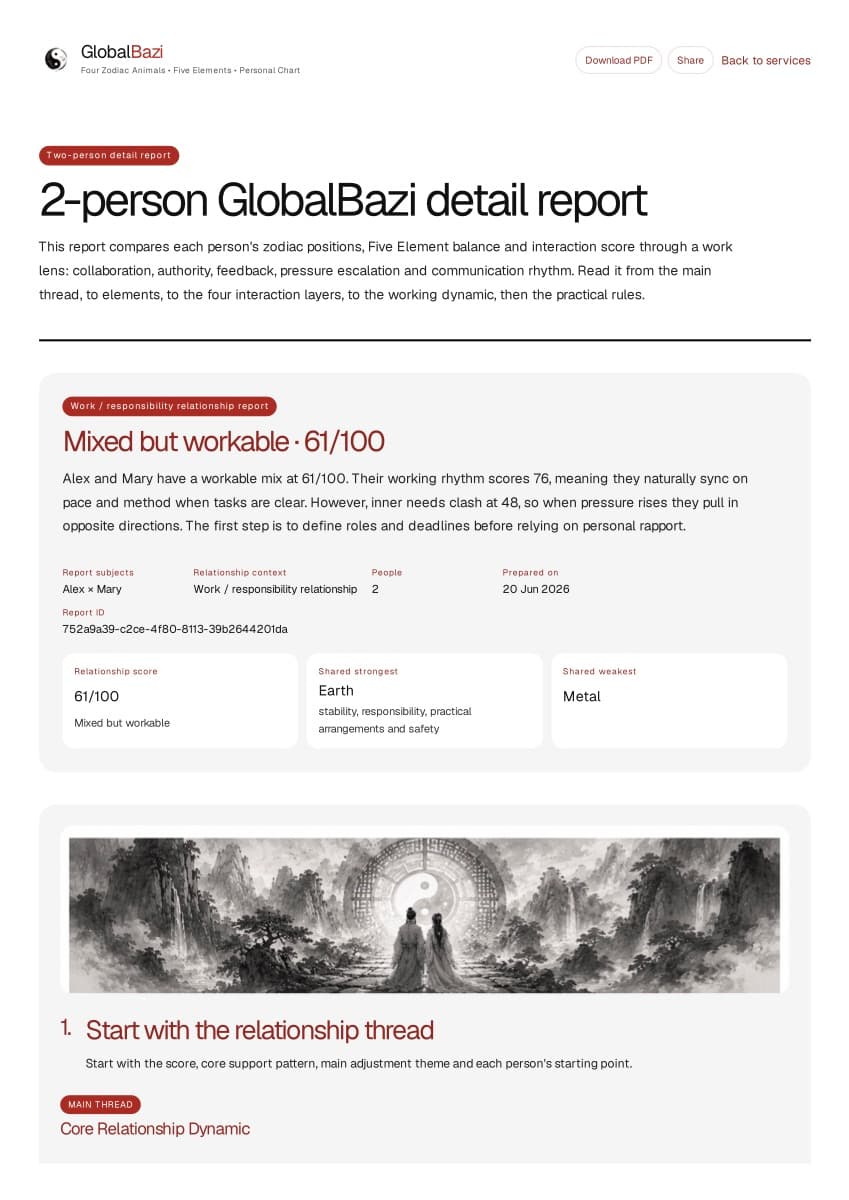
In compatibility, the 1915 year sign can show one public layer of a person, but it should not be used as a match-or-not-match rule. A two-person reading compares both full charts, including elements, pillar positions and repeated pressure patterns. For love, family or business compatibility, the year animal can start a conversation but should not end it. A two-person report compares both charts so the reading can show support patterns, stress triggers and communication gaps.
What a free GlobalBazi report adds
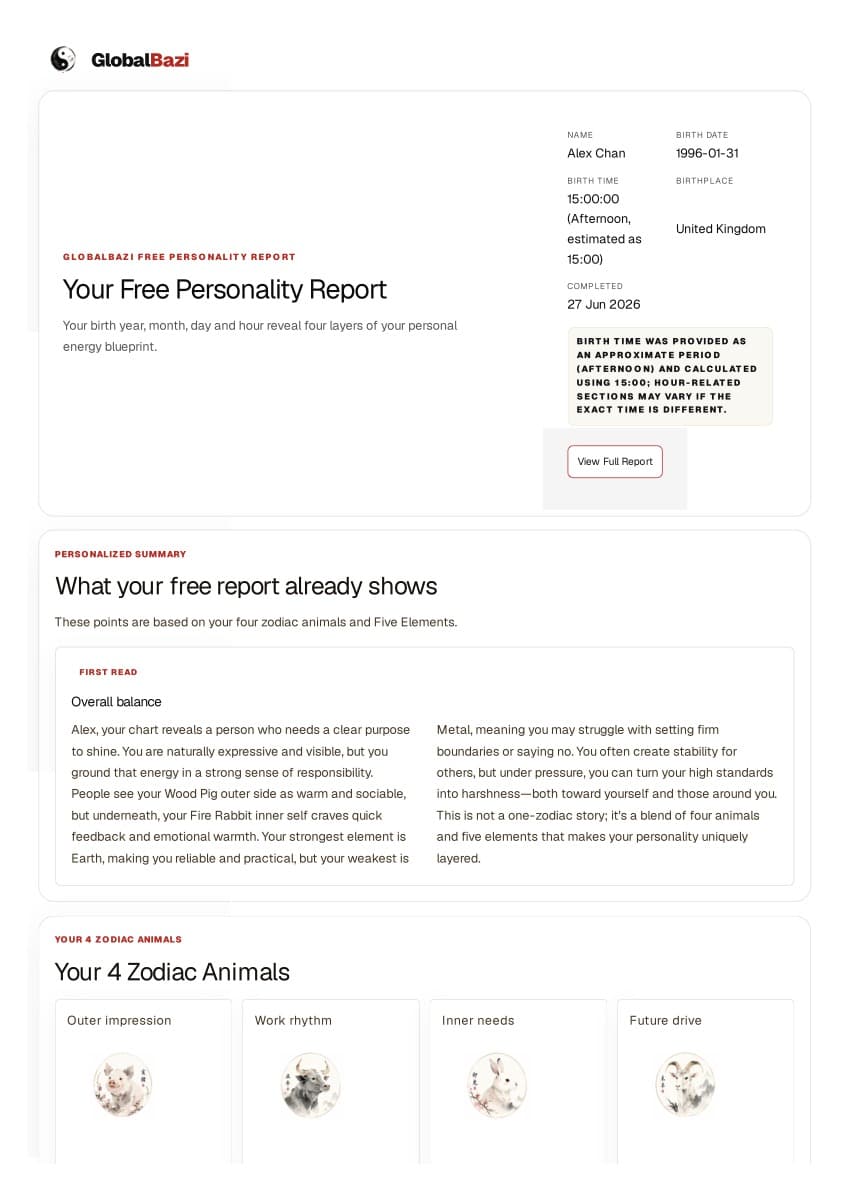
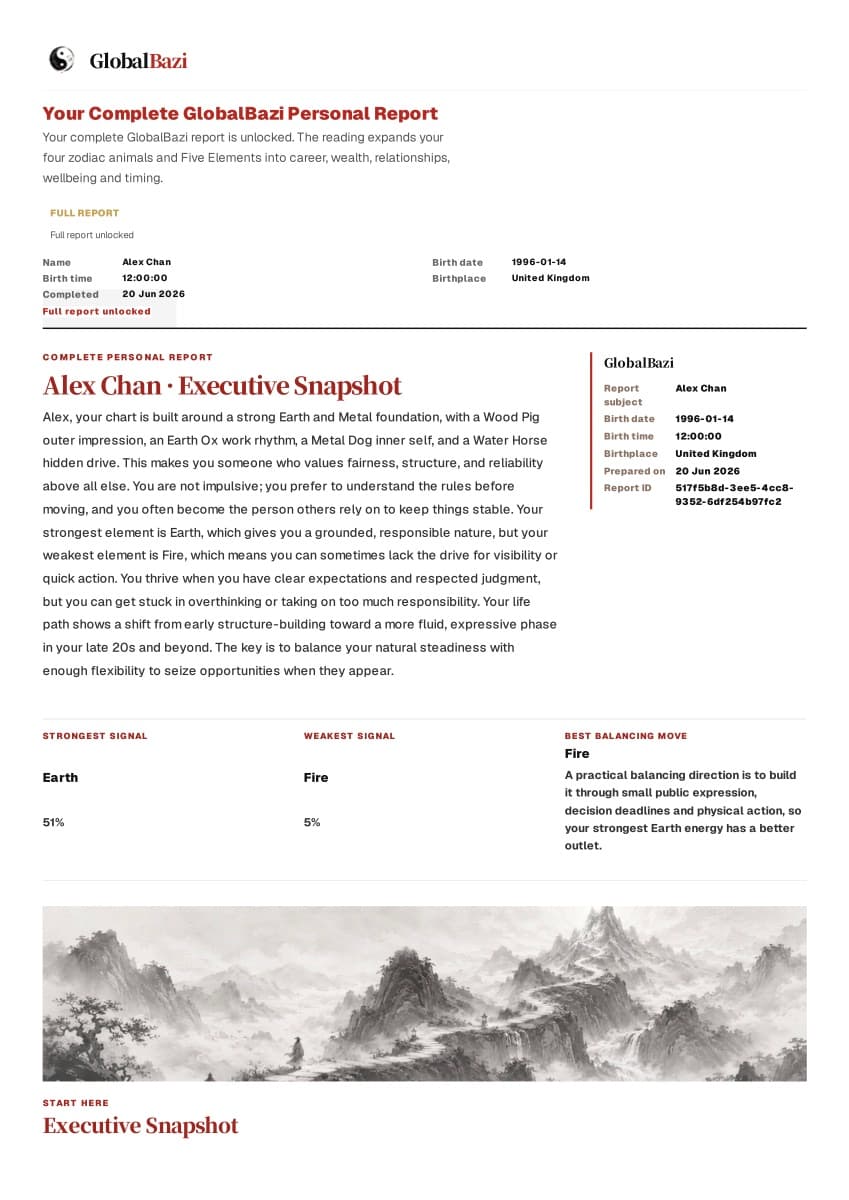
The free report starts by calculating your actual Four Pillars and Five Element balance. That means it can show whether your Rabbit year energy is supported, challenged or softened by the rest of your chart. The free report adds personal context to a simple 1915 Chinese zodiac search. It shows the four birth-chart animals, Five Elements balance and an initial interpretation so the reader can compare the year sign with the rest of the chart.
Common mistake when reading this year
The most common mistake is turning the Wood Rabbit into a personality label for everyone born in 1915. In practice, two people born in the same year can have different month, day and hour pillars, different Day Masters and different element balance. This is also why short zodiac snippets can feel accurate but incomplete. They may catch the public style of the year animal, while missing the parts that explain decisions, relationships, work rhythm and stress response.
Why you are not only your birth-year animal
A complete GlobalBazi chart can show up to four animal signs: year, month, day and hour. Someone born in a Rabbit year may still have a very different month animal, day animal and hour animal, which is why year-only zodiac descriptions often feel too broad. A person can identify with the year sign and still feel that it misses something important. That missing part is often found in the month, day or hour pillar, which is why a full Four Pillars calculator is more useful than a year-only lookup.
1915 Rabbit 2026 forecast
2026 is widely read as a Fire Horse year. For people born in a 1915 Wood Rabbit year, this does not create one fixed prediction, but it gives a useful annual lens. Fire Horse energy emphasizes movement, visibility, faster decisions and clearer personal rhythm. If your Rabbit year nature works well with action, 2026 may help with career direction, confidence and practical momentum. If your chart is already hot, rushed or overloaded, the same year can feel tiring unless rest, boundaries and priorities are clear. For love and compatibility, common zodiac references often pair Rabbit with Goat, Pig, Dog, but a full two-person BaZi reading is more specific because it compares both charts, not only birth-year animals. Use this as a reading note rather than a fortune label. The strongest next step is to generate a free BaZi report and compare the 1915 year pillar with the rest of the chart.
Best next step
Use this page to confirm the likely birth-year animal, then calculate the full chart with date, time and birthplace. That is the only way to compare the 1915 year sign with the rest of the Four Pillars. After reading this page, use the free chart if you want to compare the year sign with the other birth-chart layers. For compatibility questions, a two-person comparison can provide more context than two separate year pages.
1915 stem, branch and archive coordinates
The exact year designation is 乙卯: heavenly stem 乙, earthly branch 卯, and cycle position 52 of 60. The previous and next archived Rabbit years are 1903 and 1927. The nearest same-Ganzhi page is 1975, exactly one sexagenary cycle away. Use this as a reading note rather than a fortune label. The strongest next step is to generate a free BaZi report and compare the 1915 year pillar with the rest of the chart.
1915 boundary conventions: Gregorian, Lunar New Year and Li Chun
January 1 starts the Gregorian label 1915; popular zodiac tables often switch at Lunar New Year; BaZi normally switches the year pillar at Li Chun. The computed Li Chun boundary here is February 4, 1915 at 9:20 PM UTC, or 1915-02-05 05:20 HKT. Worked example: a birth on January 25, 1915 is before this Li Chun and therefore retains the prior 甲寅 pillar in the BaZi convention, regardless of whether a popular Lunar New Year table has already changed. Use this as a reading note rather than a fortune label. The strongest next step is to generate a free BaZi report and compare the 1915 year pillar with the rest of the chart.
How Wood compares with other Rabbit elements
This archive also contains 1903 Water, 1927 Fire, 1939 Earth, 1951 Metal, 1975 Wood Rabbit variants. Read Metal as selection and boundaries, Water as adaptation and information, Wood as growth and planning, Fire as visibility and pace, and Earth as consolidation and support. These are comparative lenses, not deterministic personality claims. Use this as a reading note rather than a fortune label. The strongest next step is to generate a free BaZi report and compare the 1915 year pillar with the rest of the chart.
Archive comparison and data quality for 1915
Treat 1915 primarily as a historical-record lookup, not as evidence about a living person's present circumstances. Handwritten civil or family records may disagree on date transcription. Time-zone standards and remembered clock time deserve explicit verification. An absent birth hour should stay marked unknown rather than being reconstructed from personality. The 1975 comparison shares cycle symbols but belongs to a different documentary setting. Use this as a reading note rather than a fortune label. The strongest next step is to generate a free BaZi report and compare the 1915 year pillar with the rest of the chart.
1915 source-verification worksheet
Build the verification worksheet around place. Preserve the birthplace wording exactly as recorded, then map it to modern coordinates in a separate field. Check whether borders, municipality names or hospitals changed without silently replacing the original location. Use the time-zone rule in force there on the birth date, not today's offset. This location-first method prevents a polished modern place name from hiding a historical conversion error. Use this as a reading note rather than a fortune label. The strongest next step is to generate a free BaZi report and compare the 1915 year pillar with the rest of the chart.